

Re: Graham Platner
A Maine Pastor's Take on the Platner Phenomenon

I have been getting questions from friends and family across the country about the Democratic nominee for Senate in Maine, Graham Platner. Those who know my politics can guess my view of his. But the Platner narrative is about more than politics; it is about Maine, cancel culture, and redemption and much more. Now, I am a pastor, not a pundit. I do not really care to talk publicly about the nitty gritty of politics, but on all the other things, I am happy to speak. So in this post I want to help explain the Platner phenomenon from a pastor’s point of view, even if I am “from away.”
Why is Platner so popular?
This is probably the first question people ask. You need a bit of context, though. Traditionally, Maine was a very rural, blue-collar state with lots of industry such as logging, paper, mining, fishing, farming, more logging, and, yes, ice-cream. These days, however, much of the industry on which the state was built has been strangulated by beaurocratic red-tape, special interest groups, and incompetent policies at the state level. There have always been cultural cities and institutions, but much of Maine traditionally identifies with the rough and tumble lobstermen. There is a kind of poverty in some places in this state which, if not quite the rival to the kind of poverty I knew in Appalachia, is certainly an analog. What money there is in the state tends to be along the coast where a symbiotic relationship has evolved between coastal elites who have vacation homes or retire here, and other people who build their homes, run the tourism industry, and make life livable. Towards the southern coast, it tends to be very blue, but further from the southern coast it melts into purple, then red.
Platner is popular, in part, because he is both from the coast and blue-collar. People look at him as a traditional, working-class guy, so there is something about the “old Mainer” in him, and, yet, he has all the policies which the progressive elite like. There are those who dispute this “narrative” of his life, and those are fair questions. But he presents as a typical, blue-class Mainer working to get by.
Do not underestimate the power of place in this contest. Mainers have an affinity to those who are “one of us.” I was jokingly told when I moved here that I was “from away”, and though some of my kids have been born here, “when you put a cat in an oven, it doesn’t make the kittens biscuits” (at least I think it was a joke). I have experienced nothing but love and gratitude for coming here from Mainers, but they know from where I am, and I am reminded of it on occasion. Like lots of other rural states, Maine also suffers from “brain drain.” Lots of kids leave Maine for college or their first job and never come back. But Platner was different. He left for his military career, but then he came back. He identifies with this place so much that he chose to come back when almost everyone else left. Do not underestimate the popularity that that kind of loyalty gets him in a place which really is pretty insulated from the national discourse.
There are other things that make Platner popular (he is really good at sound-bites, for one thing), but I want to focus on one other thing that makes him popular:
He leads from the center. Do not misunderstand: he is neither centrist nor moderate. But, what I mean is, he has the nerve to cast a vision and pull people along for the ride. He recognizes that this will turn those who do not agree with his vision off. To him, it is worth the trade-off of the people he will lose to inspire the people he gains. He is not a coalition-builder. He is not interested in making enough parties happy to grant him the win. If you are not happy with him, then you are probably not the kind of person he wants voting for him anyways. He is blazing a trail and inviting a few intrepid souls to come along with him. Whether or not you agree with his politics (I do not), you can admit that is good leadership. It has gotten him this far.
If I was to give Platner’s campaign one piece of advice: do not change that. Since he’s become the front-runner, he’s tried to posture himself more to the middle. He’s changed the way he dressed. He’s cleaned up his language. He’s gone back and forth to Washington. All of that is a bad idea. That communicates that he is just the same as all the other fancy professional politicians. The flannel-wearing, rough-and-tumble veteran, blue-collar oysterman Platner is what the people want.
Can he win?
At this point, I think not. He underperformed in the Democratic primary against Janet Mills by about 4 or 5 points when compared to the most recent polling. People over-estimated his base’s support of him. Election polls have routinely under-polled Susan Collins by about the same amount. It is hard to understand just how much of an institution she is here and how popular she is. She also brings home a lot of federal pork to a state that is starved for a good economy. It really matters. She has made a big difference in the state’s prospects because she seems to always have the ear of the man in the White House. I think most people think she has done a relatively good job. Also, and this might mean nothing, I have noticed the number of lawn signs for Platner decreasing on my running route. Which brings me to my next topic…
What about his past?
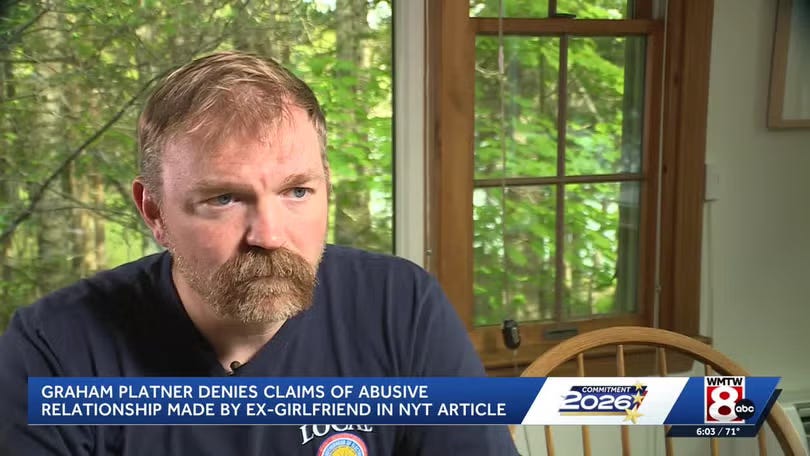
A LOT has come out about Platner’s checkered past since he declared his candidacy. At first, this did not seem to make a difference, but the steady drip of scandal has definitely dragged his campaign down. And here is where I think a pastoral word is necessary. Nobody should make excuses for some of his reddit posts or the way he treated women. It is inexcusable and intolerable. He has even referenced that this all involved the abuse of alcohol. Few things make me more angry as a pastor than when a man mistreats women. Platner has for the most part acknowledged that his past is checkered, and while these denunciations are not quite as forthcoming as I would like, I want to assume the best about him. So there is no excuse for manipulative, controlling, angry, uncontrolled, selfish men in their romantic relationships.
As a pastor, however, I believe that people can overcome their pasts. I find a lot of his critics who attack him are sanctimonious, self-righteous, and two-faced. It is hard to take their critiques of his past seriously when there are plenty of Republican politicians who have had analogous behavior in their backgrounds. I have seen people overcome some of the worst addictions, problematic behaviors, and broken marriages. Praise God that people can change. So, I think dragging him through the mud because of things that he did a decade ago and has been publicly remorseful about is wrong. It is also likely ineffectual; I think most Mainers see it for the kind of hypocritical posturing that it is.
I do think the level of vitriol against him for his past scandalous behavior makes this “do or die” for him. If he does not win the Senate, his life is probably ruined. I do not see how he can go back to things the way they were now that everybody knows the sordid details of his romantic relationships, his online habits, or his tattoos. Maine is one big small town in many ways. Which is too bad, because I think he will lose. I do wonder if the out-of-state campaign consultants who recruited him, who knew at least some of this, warned him that they might be ruining his life. Otherwise, it all seems fairly predatory.
What about his present?
Where I do not think criticisms are unfair, however, is the question of how much his past bleeds into his present. And this is the nub of the issue. For someone who has found redemption from his past, it sure seems like a lot of his past is still in his present. Let me say the quiet part out loud, “How do we know all this is really in the past?”. And I do not know the answer. I know he has only been married two years and already been unfaithful, I know he was texting inappropriately during that time, I know the reddit posts were not that long ago, I suspect he knew about his tattoo for longer than he claims, I know he had that despicable app on his phone until very recently, I know that the worst of the allegations against him he refuses to acknowledge. Is all this really behind him? Has he really changed?
What about his redemption?
And what about his redemption. This is the word that is getting thrown around a lot. What does he mean by that? Based on his victory speech—it means that he’s trying harder to be a better person every day. Ironically, for someone who is known for a bit of a libertine past, he’s a lot like the religious Pharisees Jesus faced in the first century, try harder, do more, be better. What about the people he’s wronged? Redemption is horizontal and vertical.
Has he made amends with those he wronged? Has he sought forgiveness? I know he’s gone to counseling with his wife (good idea), but has he apologized to her and asked for forgiveness? That word, “forgiveness” is strikingly absent in all this talk about his redemption. I didn’t catch it once in his victory speech. It’s hard, because it implies you believe something about wrong and right, morality and sin. It implies you do not just need forgiveness from your fellow man, but from the only One who can ultimately give it.
Has he asked the Lord to forgive him? In all of Platner’s rhetoric about this, I can’t find much reference to faith. I don’t get the sense he is a man of religious faith (he says as much in his victory speech). This is unfortunate, because I don’t know how someone can find redemption anywhere else. As an evangelical, bible-believing Christian, I would want to tell Platner that there really is Someone who can forgive all the worst things that he’s done, there really is a way to get his past in the past, there really is a place to find true redemption. There is someone who knows all the things that have come out, that have not yet come out, and that he prays never will come out—and who will take him anyways. It doesn’t matter if he wins or loses the election: the offer is still there. In fact, I believe that Jesus died on the cross, he suffered our curse, his life was ruined, so that we could have eternity, receive his blessing, and live lives made new. And so that we could be forgiven.
I really believe in this thing called Hell. I think among the first to go there will be people who are unrepentant in their sanctimonious, pharisaical self-righteousness. Jesus is harsher with religious hypocrites than with anyone else. That includes, however, those who claim to have changed when they haven’t. But the good news is that Jesus still forgives. True redemption really is possible, even for someone like Graham Platner. Maybe he has that, if he does, he’s been remarkably hush-hush about the whole thing. But if you do not have that, Graham, Jesus was broken so you could be made whole. That’s what Maine needs, and that’s what you and I need too.
An Open Offer
I want to end by extending an open offer to Graham or anyone on his campaign who cares. I don’t expect that they will respond, but, hey, Maine is kind of one big small town. If you ever want to get together with a normal person who you probably disagree with but does not hate you, who is happy to get to know you, hear more of your story, and to pray with and for you, the door is open. I will break bread with you. I will not be repulsed by you. I will treat you like a normal human being. Shoot me a direct message. I’m not far from Surry.
P.S. I was looking for a way to work this in to the rest of the article, but I couldn’t: I am so sorry about the miscarriage. I know that must be devastating in a time when the rest of your world is in upheaval. Children are a blessing, and when that blessing is withheld, it seems unbelievably unfair. Please know that, from the bottom of my heart, I do extend sympathy to you. I do pray that the God of all mercy and the Father of all comfort would minister that same comfort and mercy to you both in this.
Thanks for writing this Matt! Well done